A headless content management system (CMS) is a platform that stores content as structured data and delivers it through an application programming interface (API) to any front-end.
It separates content from presentation, so the same article, product entry, or FAQ can flow to a website, a mobile app, or an AI assistant.
In 2026, that structure matters more than ever. AI agents and answer engines read structured content far better than they read page templates, which makes the right CMS a competitive advantage.
What Is a Headless CMS?
A headless CMS is a content infrastructure that delivers structured content over APIs instead of rendering web pages itself. The "head," meaning the presentation layer, is a separate application built in frameworks like React or Vue. This decoupling is what makes a headless CMS useful for an AI-era content stack.
The reason is simple. AI agents, retrieval-augmented systems, and answer engines need clean, structured, queryable content. They struggle with HTML blobs glued to templates. A well-modeled headless CMS exposes content as predictable data, so machines and humans can both consume it.
That shift has real money behind it. The global headless CMS software market was valued at USD 1.75 billion in 2025 and is projected to reach USD 6.23 billion by 2033, according to Grand View Research. For background on the broader category, see the NetworkPoppins Technology coverage hub.
How to Evaluate a Headless CMS for an AI Content Stack
The best headless CMS platforms are judged on more than a content editor. For an AI-era content stack, six criteria separate strong platforms from weak ones. Screening on these avoids an expensive migration later, the same discipline NetworkPoppins applies in its SASE vendor evaluation checklist.
1. API maturity: Reliable REST and GraphQL APIs with fast, cacheable reads.
2.Content modeling: Flexible, reusable schemas, not rigid page templates.
3. Native AI tooling: Generation, translation, and summarization built in, not bolted on.
4. Agent and MCP support: A Model Context Protocol (MCP) server lets coding agents manage content directly.
5. GEO and AEO readiness: Structured output that AI engines can parse and cite.
6. Total cost: Seat, API, and hosting pricing that scales with real usage.
The 12 Best Headless CMS Platforms for 2026
The best headless CMS platforms in 2026 balance developer control, editor usability, and native AI features. The shortlist below covers enterprise suites, open-source frameworks, and marketer-friendly tools, so teams of any size can find a fit.
1. Contentful
Contentful is the enterprise standard for global content operations at scale. It serves more than 4,800 brands, including a large share of the Fortune 500. The platform pairs a mature, API-first architecture with strong governance and a deep integration ecosystem. In June 2026, Salesforce signed a definitive agreement to acquire Contentful to give its Agentforce agents a native content layer, a signal of where the market is heading.
● Founded: 2013 ·
● HQ: Berlin, Germany ·
● Services: composable content platform,personalization, integrations
● Differentiator: enterprise scale plus theAgentforce roadmap ·
● Trust signal: ~4.3/5 on G2.
G2 Ratings:

2. Sanity
Sanity is built for teams that want real-time collaboration and a fully customizable editing studio. It rebranded itself as a "Content Operating System for the AI era," reflecting a focus on structured, queryable content. Its GROQ query language and live editing make it a favorite for product and editorial teams. Developers get deep customization, while editors get a polished workspace.
● Founded: 2017
● HQ: Oslo, Norway, and San Francisco
● Services: structured content, real-timestudio, content lake
● Differentiator: customizable, AI-ready contentmodeling
● Trust signal: ~4.6/5 on G2.
G2 Ratings:

3. Storyblok
Storyblok positions itself as a headless CMS made for humans and built for the AI-driven content era. Its visual editor lets marketers create and manage pages without developer support. The component, or block, architecture organizes content into nestable pieces that AI engines can crawl and reuse. That makes it strong for both editor speed and answer-engine visibility.
● Founded: 2017
● HQ: Linz, Austria
● Services: visual editor, component blocks,localization
● Differentiator: visual editing withmachine-readable structure ·
● Trust signal: ~4.6/5 on G2.
G2 Ratings:

4. Strapi
Strapi is the leading open-source, self-hosted headless CMS for teams that want full control. Built on Node.js, it offers customizable APIs and a flexible admin panel. Strapi shipped an official Model Context Protocol server, so coding agents can manage content directly. That makes it a practical choice for developer teams building agent-driven workflows.
● Founded: 2015
● HQ: Paris, France
● Services: open-source CMS, self-hosting,plugin ecosystem
● Differentiator: open-source control plus MCPsupport
● Trust signal: ~4.5/5 on G2.
G2 Ratings:

5. Contentstack
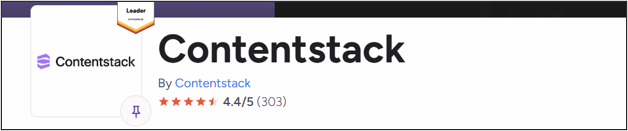
Contentstack is an enterprise composability leader recognized in analyst evaluations of the category. It combines a headless CMS with customer data, AI-driven content, and personalization. The platform targets regulated and large-scale sectors that need governance and reliability. For enterprises building best-of-breed stacks, it is a frequent shortlist entry.
● Founded: 2018
● HQ: San Francisco, United States
● Services: composable DXP, personalization, AIcontent
● Differentiator: enterprise composability andgovernance
● Trust signal: ~4.5/5 on G2.
G2 Ratings:
6. Hygraph
Hygraph, formerly GraphCMS, is a GraphQL-native headless CMS focused on content federation. Federation merges data from many sources into one repository through APIs, without duplicating content. That suits multi-brand publishers and businesses with fragmented systems. Companies, including Samsung and Telenor, have used it for reusable, consistent content models.
● Founded: 2017
● HQ: Berlin, Germany
● Services: GraphQL CMS, content federation,localization
● Differentiator: native GraphQL andmulti-source federation
● Trust signal: ~4.6/5 on G2.
G2 Ratings:

7. Prismic
Prismic pairs a headless CMS with a page-building approach centered on reusable components called Slices. Marketing teams assemble landing pages from approved blocks without engineering for every change. That balance of structure and speed makes it popular for content-led websites. It also maintains a strong focus on SEO and AI search visibility.
● Founded: 2013
● HQ: Paris, France
● Services: headless CMS, Slice page builder,SEO tooling
● Differentiator: component-based pages formarketers
● Trust signal: ~4.4/5 on G2.
G2 Ratings:

8. Payload CMS
Payload is a TypeScript-native, open-source headless CMS and application framework built around Next.js. Developers define content models in code and receive REST, GraphQL, and local APIs automatically. Payload shipped an MCP server and was acquired by Figma in June 2025, deepening its design-to-content vision. It remains free under the MIT license, with self-hosting available anywhere.
● Founded: 2022 ·
● HQ: Grand Rapids, United States
● Services: code-first CMS, app framework,self-hosting
● Differentiator: TypeScript-native, agent-readyarchitecture
● Trust signal: ~4.8/5 on G2.
G2 Ratings:

9. Directus
Directus is an open-source platform that wraps any SQL database and turns it into an instant API. This data-first model suits organizations working with structured datasets rather than only editorial content. It offers both REST and GraphQL, plus a clean admin interface for non-technical users. Teams at Bose and other data-heavy organizations have adopted it.
● Founded: mid-2010s (open source) ·
● HQ: United States
● Services: data platform, instant API,self-hosting
● Differentiator: any SQL database as a contentAPI
● Trust signal: ~4.7/5 on G2.
G2 Ratings:

10. Kontent.ai
Kontent.ai is a software-as-a-service headless CMS built for governance and content operations at scale. It grew out of the Kentico ecosystem and focuses on modular workflows for large teams. Marketers and developers plan, create, and deliver experiences across channels within a managed platform. Strong roles, permissions, and process controls make it enterprise-friendly.
● Founded: 2015 (as Kentico Kontent)
● HQ: Brno, Czech Republic
● Services: SaaS CMS, content operations,governance
● Differentiator: structured governance forlarge teams
● Trust signal: ~4.5/5 on G2.
G2 Ratings:

11. Builder.io
Builder.io blends a headless CMS with visual development tools. Its AI feature, Visual Copilot, converts Figma designs into production code, narrowing the gap between design and delivery. Marketers can edit live pages visually, while developers keep control of the codebase. That positions it well for teams that want speed without sacrificing flexibility.
● Founded: 2018
● HQ: United States
● Services: visual CMS, design-to-code AI,experimentation
● Differentiator: Figma-to-code generation
● Trust signal: ~4.6/5 on G2.
G2 Ratings:

12. DatoCMS
DatoCMS is an API-first, GraphQL headless CMS popular with agencies and publishers. It bundles a built-in image content delivery network and a clean editing experience. The platform emphasizes performance and a sustainable, carbon-aware infrastructure. For teams shipping many fast, media-rich sites, it is a reliable choice.
● Founded: 2016
● HQ: Italy
● Services: GraphQL CMS, image CDN, localization
● Differentiator: performance with asustainability focus
● Trust signal: ~4.7/5 on G2.
G2 Ratings:

Headless CMS Trends Shaping AI Content Stacks in 2026
The defining headless CMS trend for 2026 is the shift from content management to content orchestration for AI. Platforms are racing to make content readable and actionable by autonomous agents. Three movements stand out.
First, AI-native positioning is now the default. Sanity rebranded around an "AI era" content operating system, and most vendors ship generation and translation features.
Second, agent access is becoming standard. Strapi and Payload both released MCP servers, letting coding agents create and edit content programmatically.
Third, consolidation is accelerating. Salesforce's move to acquire Contentful for Agentforce shows large platforms buying content layers to feed AI agents. Gartner predicts that by 2027, 50% of organizations will fail to deliver impactful digital customer experience without an AI-driven content coordination strategy. Clean data underpins all of it, a theme echoed in the NetworkPoppins guide to the top data cleansing tools.
What AI-Era CMS Selection Means for Content and Marketing Teams
For content and marketing teams, the CMS choice now shapes AI search visibility, not just publishing speed. Structured content is what AI Overviews, Perplexity, and ChatGPT search can parse and cite. A poorly modeled CMS hides good content from these engines.
As Gartner's Irina Guseva put it, "The once commoditized content management foundation takes the front seat again... Your Agentic AI is only as good as your content and data." The practical takeaway is to prioritize content modelling and governance before chasing flashy generation features.
Marketing leaders should also weigh editor experience against developer needs. Visual platforms like Storyblok and Builder.io reduce engineering bottlenecks.
The Standout Platforms for Most Teams
For most teams in 2026, two platforms stand out from this list, depending on the team profile. NetworkPoppins recommends them as starting points, not as the only valid choices.
For enterprises that need scale, governance, and a clear AI roadmap, Contentful is the safest default, especially given the Salesforce and Agentforce direction. Larger organisations evaluating composability should also shortlist Contentstack.
For developer-led teams that value control and want agent-ready infrastructure today, Payload is the strongest pick. Its open-source license, TypeScript foundation, and MCP server fit modern AI workflows. Teams wanting open-source flexibility without code-first commitment should compare it against Strapi. The right answer always depends on team skills, budget, and channel mix.
Choosing the Right Content Foundation for an AI-First Web
The best headless CMS platforms in 2026 share one trait: they treat content as structured, machine-readable data ready for AI agents and answer engines. That foundation now decides whether content gets discovered, reused, and cited across channels.
The smartest approach is to score candidates against the six criteria above, then run a small proof of concept before committing. Match the platform to the team, not the hype. A developer-first stack and a marketer-first stack lead to different shortlists, and both are valid. Get the content model right, and the AI capabilities will have something worth working with.
FAQs
Is a headless CMS better than WordPress for AI search visibility?
Often, yes. A headless CMS delivers structured, API-first content that AI engines parse and cite more easily than template-bound pages. WordPress can be run headlessly, but most installs couple content to themes, which limits clean, structured output.
Are there free or open-source headless CMS platforms?
Yes. Strapi, Payload, and Directus are open-source and self-hostable at no license cost. Many SaaS platforms, including Hygraph and DatoCMS, also offer free tiers for small projects and experimentation.
What is an MCP server in a headless CMS, and why does it matter?
A Model Context Protocol (MCP) server lets AI coding agents read a schema and manage content directly. It matters because it allows agents to draft, translate, and publish without a human clicking through screens. Strapi and Payload both ship official MCP servers.
How is a headless CMS different from a composable DXP?
A headless CMS manages and delivers content through APIs. A composable digital experience platform (DXP) adds personalization, customer data, analytics, and orchestration on top. Many headless CMS vendors now expand toward DXP territory.
Do headless CMS platforms actually help with GEO and AEO?
They help by structuring content so Generative Engine Optimization (GEO) and Answer Engine Optimization (AEO) systems can extract clear answers. Structure does not guarantee citations, but unstructured content makes them far less likely.

Featured articles
Explore the cutting-edge of network and security: Dive into our featured articles, packed with expert insights and practical tips