- The no-code and low-code category has shifted from visual drag-and-drop building to AI-driven, intent-based creation, where you describe an app in plain English and the platform drafts it.
- Gartner expects 75% of new applications to be built with low-code or no-code tools by the end of 2026, and has renamed its enterprise category to “AI-Augmented Low-Code Application Platforms.”
- The single category has fractured into enterprise low-code, internal tool builders, AI app builders (Lovable, Bolt, v0, Replit), and no-code app builders — each evaluated differently.
- The upside is speed and broader access; the new risk is ungoverned, AI-generated apps, so governance and data control matter more than ever.
The no-code and low-code platform category has changed more in the past two years than in the decade before it. The AI shift turned tools built around drag-and-drop canvases into systems that draft entire applications from a sentence, and in doing so it split one tidy market into several overlapping ones.
This piece explains what actually changed since AI arrived, how the category now breaks down, and what operations and IT leaders should weigh before buying into the new landscape.
What No-Code and Low-Code Mean Today
No-code platforms let non-developers build apps through visual interfaces with no programming, while low-code platforms speed up development for technical teams by combining visual building with the option to drop into code. The line between them was always blurry, and AI has blurred it further.
The momentum is hard to overstate. Gartner expects 75% of new applications to be built with low-code or no-code tools by the end of 2026, up from less than 25% in 2020, and forecasts that by 2028 roughly 45% of new application code will be AI-generated, much of it through these interfaces.
What Changed Since the AI Shift
AI did not just add a feature to these platforms. It changed how apps get made, who makes them, and what a “platform” even is.
From Drag-and-Drop to Intent-Based Building
The most profound change is the move to intent-based creation, often called “vibe coding.” Instead of dragging components onto a canvas, you describe the outcome — “a tool that flags invoice discrepancies and emails the vendor” — and the AI drafts a data model, suggests the interface, and wires up the APIs. Visual editing still exists, but it has become the refinement step, not the starting point.
From Building Apps to Recording Workflows
For a large class of back-office work, you no longer build an app at all. You record an existing process and AI turns it into deterministic code that runs over your existing tools’ APIs, with nothing to design, host, or version. The “app” quietly disappears into automation.
AI Moved Inside the Platform
Copilots, code generation, and agentic workflows are now native rather than bolted on, cutting prototyping time by an estimated 40 to 50%. Gartner has even renamed its enterprise category to AI-Augmented Low-Code Application Platforms, a clear signal that AI capability is now table stakes, not a differentiator.
The Category Fractured
Because AI lowered the cost of generating real code, the old single category split apart. Buyers now compare enterprise low-code platforms, internal tool builders, workflow automation suites, AI app builders, and no-code startup tools side by side, even though they solve different problems.
Before and After the AI Shift
The table below captures how the category changed across the dimensions that matter most to buyers.
| Dimension | Before the AI shift | After the AI shift |
|---|---|---|
| How you build | Drag-and-drop visual builders | Describe the outcome in plain English, then refine |
| Who builds | IT teams and trained citizen developers | Almost anyone, with AI drafting the first version |
| What you build | Apps and forms on a platform | Apps, plus recorded workflows that run as code |
| Speed | Faster than hand-coding | 40–50% faster prototyping on top of that |
| Output | Platform-locked applications | Some tools export real, portable production code |
| Main risk | Shadow IT and app sprawl | Ungoverned, AI-generated apps and data exposure |
The Category, Split Into Segments
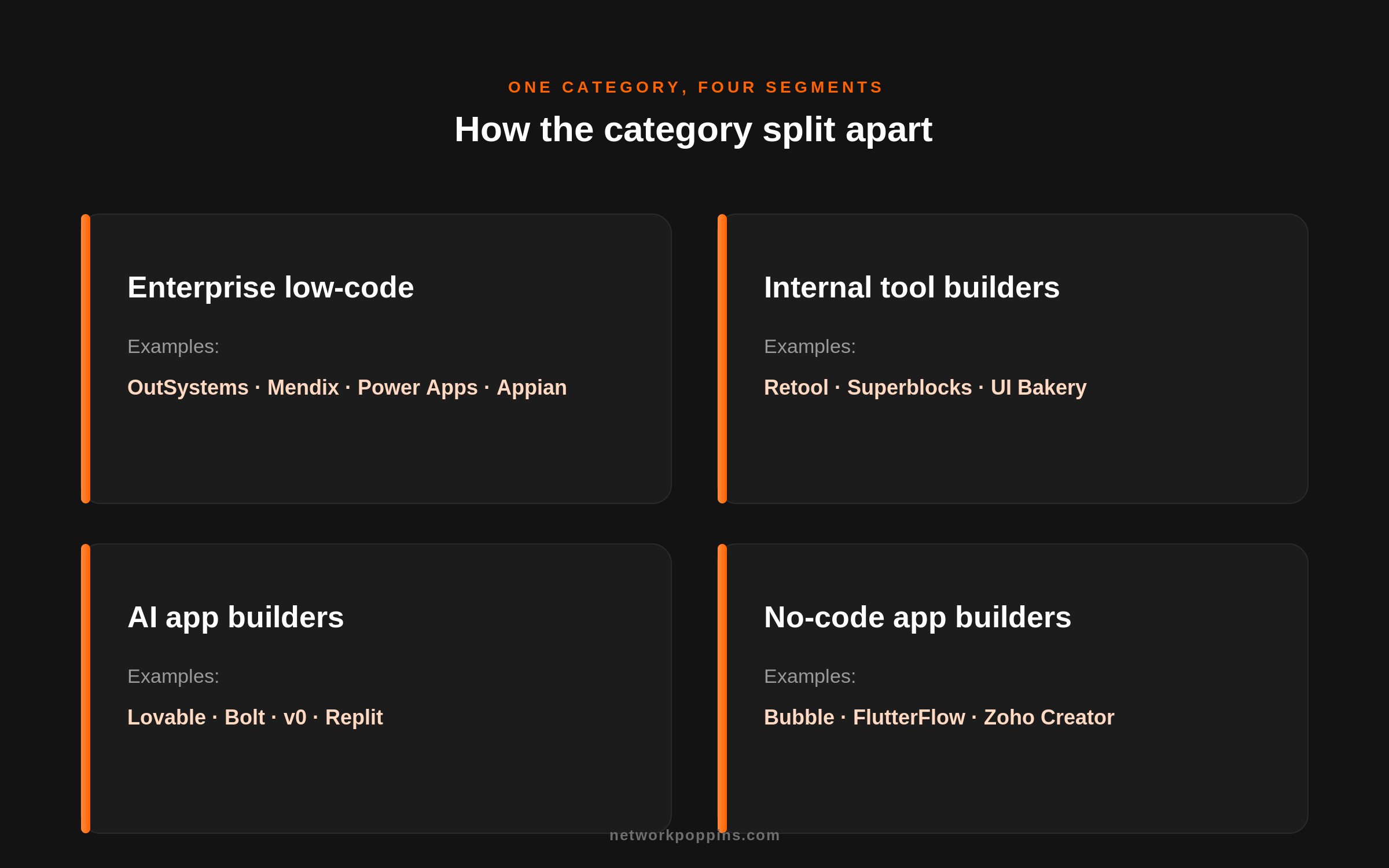
“No-code/low-code” is now an umbrella over distinct segments. Knowing which one you are buying prevents an expensive mismatch.
| Segment | What it is | Example platforms | Best for |
|---|---|---|---|
| Enterprise low-code | Governed platforms for IT-led, scalable apps | OutSystems, Mendix, Power Apps, Appian, ServiceNow | Customer and core internal apps |
| Internal tool builders | Fast UIs over your own data and APIs | Retool, Superblocks, UI Bakery | Dashboards and operations tools |
| AI app builders | Prompt-to-app that generates real code | Lovable, Bolt, v0, Replit | Speed with code-level flexibility |
| No-code app builders | Visual builders for non-developers | Bubble, FlutterFlow, Zoho Creator | Startups, MVPs, and simple apps |
What the AI Shift Means for Operations and IT Leaders
The headline is access: roughly 16 million citizen developers were building apps worldwide in 2026, and Gartner expects them to outnumber professional developers four to one in large enterprises by 2028. That unlocks enormous throughput, but it also means more people can ship software that touches real data.
So the governance question moves to the center. AI-generated apps need the same controls as any other software: access policies, data-loss prevention, and a clear inventory of what exists. The discipline is the same one we cover in adjacent areas, from keeping a clean data foundation to the agentic governance themes in our guide to AI agent platforms for enterprise operations.
Where the Category Goes Next
Three directions look durable. First, the builder becomes a conversation, with visual editing as a fallback rather than the default. Second, the platforms converge with automation and AI agents, which is why “platform” now matters more than “builder.” Third, the segments keep specializing, so the smart move is to match the tool to the job rather than chase one platform for everything.
For more on the technologies reshaping modern stacks, explore the NetworkPoppins Technology coverage and our breakdown of the best headless CMS platforms.
Choosing in the New Category
The no-code and low-code category did not get simpler after the AI shift; it got faster, broader, and more fragmented. The winning approach is to decide which segment fits the problem, weigh AI capability alongside governance and data control, and pilot before standardising. Do that, and AI-era low-code becomes a genuine throughput multiplier rather than a new source of sprawl.
FAQs
What is the difference between no-code and low-code?
No-code platforms let non-developers build apps visually with no programming, while low-code platforms add the option to extend apps with code. Low-code scales further for complex needs; no-code is faster for simple ones.
How has AI changed no-code and low-code platforms?
AI shifted the category from drag-and-drop building to intent-based creation, where you describe an app in plain English and the platform drafts the data model, interface, and integrations. Copilots and agents are now native to most platforms.
What is vibe coding?
Vibe coding is intent-based development: you describe the outcome you want in natural language and AI generates a working first version. You then refine it visually or in code, rather than building every component by hand.
Are AI app builders the same as no-code platforms?
Not quite. AI app builders such as Lovable, Bolt, v0, and Replit generate real production code from prompts, offering more flexibility than visual no-code tools while keeping much of the speed.
Is low-code or no-code safe for enterprise use?
Yes, with governance. Because AI now lets far more people build apps that touch real data, enterprises need access controls, data-loss prevention, and an inventory of what has been built to avoid ungoverned sprawl.

Featured articles
Explore the cutting-edge of network and security: Dive into our featured articles, packed with expert insights and practical tips